
Playing Tennis Alone: Ball Machines in Bulgaria
April 23, 2026
Most recreational players don't play as often as they'd like — because tennis traditionally needs a partner. A ball machine removes that problem entirely. Here's what solo tennis with a machine looks like in Bulgaria, what it costs, and whether it's right for you.
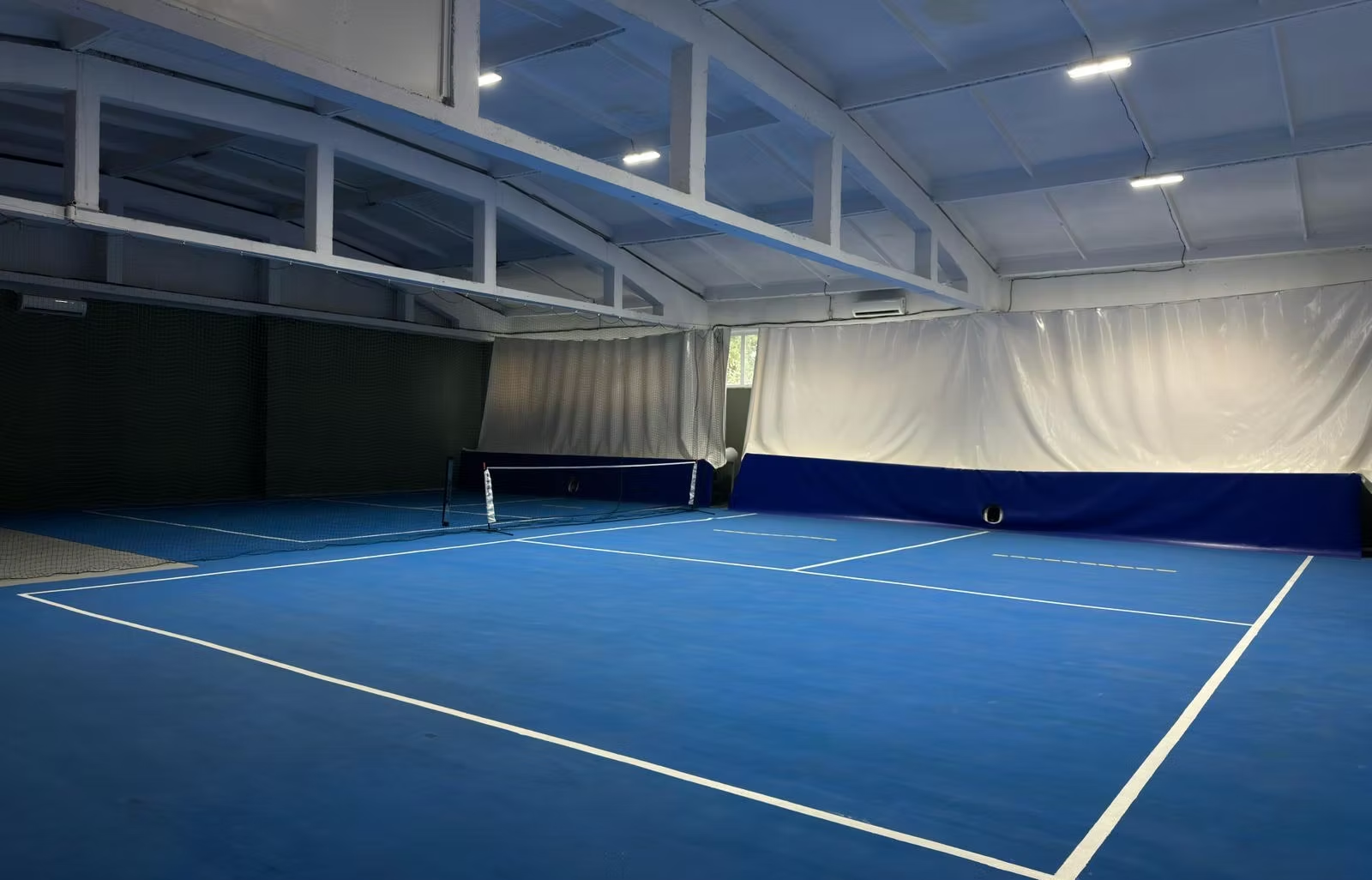
Playing Tennis Alone: The Beginner's Guide to Ball Machines in Bulgaria
Most people who want to play tennis don't play as often as they'd like. The reason isn't time, money, or motivation — it's that tennis is traditionally designed for two. You need a partner. You need to coordinate. You need to be at the same level. If any part of that breaks down, you don't play.
A ball machine removes the problem entirely. Here's what that actually means in practice, what it costs in Bulgaria, and whether it's worth it.
What a ball machine actually does
A tennis ball machine is a device that feeds tennis balls at a controlled speed, spin, and interval. Professional machines can vary all three, aim at different parts of the court, and run pre-programmed drill patterns. You stand on one side of the court and hit the balls the machine sends you. When you've hit all the balls, you (or the machine) collect them and start again.
That's the mechanical explanation. The useful explanation is this: a ball machine gives you more hits per unit of time than any other tennis format. In 30 minutes with a machine, you can hit 500+ balls. In 30 minutes playing singles with a partner of similar level, you might hit 100–150. That difference matters enormously if you're trying to improve a specific stroke.
Why solo practice is underrated
Most recreational players think of tennis as a partner sport, and they treat solo practice as a poor substitute for "real" tennis. That's a mistake. Almost every professional player spends more time in solo practice (with a ball machine, with a coach feeding balls, or against a wall) than in match play.
The reason is that solo practice isolates what you're working on. If you want to fix your backhand, playing a set against a partner gives you maybe 30 backhands across an hour, most of them under inconsistent conditions. A ball machine gives you 300 backhands in 30 minutes, all in the same conditions, with small controlled variations. That's ten times the reps with less noise in the signal.
If you're trying to build a new stroke or fix a bad habit, solo practice isn't a compromise. It's the main tool.
The three ways to access a ball machine in Bulgaria
1. Buy your own. Professional ball machines cost between €1,500 and €4,000. They're portable but heavy, require charging or mains power, and you still need a court to use them on.
2. Rent one by the hour at a traditional club. Some clubs in Bulgaria have ball machines available to members and occasionally to non-members for an hourly fee. The combined cost (court + machine rental) usually lands at €15–25 per hour, depending on the club. You also need to book the court separately and bring/borrow the machine.
3. Use a self-service facility built around ball machines. This is the newest option in Bulgaria. Playbox Courts in Plovdiv is currently the only fully self-service ball-machine venue in the country. Pricing starts at €2 per 30 minutes at off-peak hours, machine included, court included, no membership required. It's by far the cheapest per-session option for people who want to use a ball machine regularly.
Who solo ball-machine practice is actually for
A ball machine is particularly useful if you:
- Are learning tennis as an adult. Consistent reps matter more than variety in the first 50 hours. A machine gives you exactly that.
- Are rebuilding your game after years away. Muscle memory returns faster with volume than with complexity.
- Have a specific stroke weakness. Machine drills let you work on one thing without distraction.
- Can't find a regular hitting partner. Most recreational players have this problem. A machine solves it entirely.
- Have unpredictable work schedules. You don't need to coordinate with anyone.
A ball machine is less useful if you:
- Mostly want to play matches. A machine can't replicate match pressure, tactics, or the unpredictability of a human opponent.
- Are already at a strong competitive level. You'll still benefit, but the gains are smaller than for intermediate players.
- Mainly play tennis for the social aspect. A machine is the opposite of social.
Most serious recreational players end up combining both — machine sessions for technique, matches and social tennis for enjoyment and competition.
What a session actually looks like
If you've never used a ball machine, here's what a 30-minute session typically looks like:
- Minutes 0–5: Setup and warm-up. You configure the machine for a slow speed, long intervals, one spot. Simple forehand rally with yourself. Find the contact point.
- Minutes 5–15: Your main drill. Pick one thing — say, forehand crosscourt. Medium speed, repeatable pattern. Focus on quality, not volume. If you feel the form breaking down, slow the machine down.
- Minutes 15–25: Variation. Same stroke, but now vary spin or depth. Or switch to the other wing. The goal is to apply the same form under slightly different conditions.
- Minutes 25–30: Cooldown. Easy rallies, low speed, no pressure. Let the body and mind decompress.
You will hit somewhere between 400 and 700 balls in that 30 minutes. That's more reps than an entire week of doubles would give you.
Cost comparison over a year
If you want to use a ball machine regularly — say, twice per week — here's roughly what it costs over a year in Bulgaria:
- Owning your own machine: €2,500 upfront + court fees of ~€8–15 per session × 104 sessions = €3,300–4,000 first year, then €830–1,560 per year thereafter.
- Renting at a traditional club: €15–25 per session × 104 = €1,560–2,600 per year.
- Self-service (Playbox Courts, off-peak): €2–4 per 30-minute session × 104 = €210–420 per year.
The cost difference isn't marginal. For regular users, self-service ball-machine tennis is roughly an order of magnitude cheaper than the alternatives. That's the whole economic argument for the format, and it's why it has expanded so quickly in countries where it exists.
The bottom line
If you've wanted to play tennis more often but can't find partners, can't justify coaching fees, or simply want to work on your game at your own pace — solo practice with a ball machine is the answer. It used to be an expensive niche in Bulgaria. As of 2026, it isn't. For €2 and thirty minutes, you can try the format and decide whether it fits how you want to play.